

1. Introduction – Safeguarding at the heart.
Walthew House seeks to provide an environment where everyone can work safely, and children, young people and adults at risk can engage and enjoy taking part in activities.
It is Walthew Houses’ policy to safeguard the welfare of children, young people and adults at risk involved in the work we do by protecting them from neglect, physical, sexual or emotional abuse, harassment and discrimination. It is also our policy to provide those working for or with Walthew House a clear and robust framework to operate within to keep everyone who is engaged in the Charities activities safe.
Walthew House and its individual staff members have a duty of care to ensure the protection of the young people they are working with, from unnecessary risk and/or harm. The protection of young people is based on the principles outlined within the Children’s Act 2004, the United Nations Declaration on the Rights of the Child (1959) and Working Together 2018 (& 2020 updates) Guidance. The principles recognise the welfare of the young person is paramount and all young people, regardless of age, disability, gender reassignment, race, religion or belief, sex, or sexual orientation have the right to protection from all types of harm and abuse.
It is essential that everyone is clear how to report a concern about the welfare of young person. This means following the guidelines set out in this policy.
2. Policy Statement
This document outlines Walthew Houses safeguarding policy and procedures for the protection of children and young people at risk. For the purposes of this policy:
- ‘Children and young people’ – includes anyone up to the age of 18.
- The young people who access Walthew House youth group have disabilities (Deaf, VI and/or additional needs) which can make them more vulnerable and at higher risk of abuse.
- Vulnerable young adults – The principles of this policy extend to young people over the age of 18 due to the effect their disabilities can have – special communication needs and extended need for advocacy and supervision. To ensure we can support safely and appropriately on an individual basis risk assessment will be undertaken.
Every organisation and its individual staff members have a duty of care to ensure the protection of the young people they are working with, from unnecessary risk and/or harm. The protection of young people is based on the principles outlined within the Children’s Act 2004 and the United Nations Declaration on the Rights of the Child (1959) and Working Together 2018 (& 2020 updates) Guidance.
The principles recognise the welfare of the young person is paramount and all young people, regardless of age, disability, gender reassignment, race, religion or belief, sex, or sexual orientation have the right to protection from all types of harm and abuse. It is essential that everyone is clear how to report a concern about the welfare of young person. This means following the guidelines set out in this policy.
3. Principles
- This policy is based on the legal and statutory definitions of a child (defined as being up to 18 years old).
- The organisation will safeguard the welfare of children, young people and adults at risk, within the work we do by protecting them from neglect, physical, sexual or emotional abuse.
- All young people, regardless of age, culture, any disability they may have, gender, language, racial origin, religious belief, gender reassignment or sexual identity have the right to protection from any kind of abuse.
- All young people have the right to participate in an enjoyable and safe environment.
- Young people have the right to expect appropriate support in accordance with their personal and social development.
- Working in partnership with young people, their parent(s)/carers and other agencies is essential for the protection of young people.
- Safeguarding children and young people is the responsibility of everyone within the organisation, regardless of their role.
- A timely and appropriate response will be given to all suspicions or allegations of abuse, or poor practice.
- It is the responsibility of the Designated Safeguarding Lead/Leadership Team and any external agencies involved to uphold safeguarding criteria thresholds.
- The sharing of confidential information is shared on the risk of harm basis. That there is a reasonable belief that a child is at risk of significant harm, neglect, abuse and sharing is necessary to protect their welfare.
- All personal information about children & young people is shared and stored appropriately in accordance with the Data Protection Act, the Freedom of Information Act and Information Sharing Protocols.
4. Legal framework
Walthew House recognises our statutory responsibility to ensure the welfare of young
people and work with the Local Safeguarding Children’s Partnership (LSCP) to comply with its safeguarding procedures.
For details of legislation and up to date information on Child Protection see: Working together to safeguard children – GOV.UK
5. Implementation
This policy applies to:
- anyone working on behalf of Walthew House, including senior managers and the board of trustees, paid staff, volunteers, sessional workers, agency staff and young people.
- All other bodies working in partnership with the organisation.
6. Monitoring Procedures
Walthew Houses‘s Safeguarding and Child Protection Policy is monitored annually, and a full policy review will be undertaken bi-annually. The following situations may also trigger a review of the policy:
- Any changes in legislation
- Any changes in youth governance
- The result of a significant case
7. Supporting policies and documents
Walthew House has an existing set of policies that are regularly reviewed, alongside this detailed at appendix 1 is the National Youth Agencies best practice guidance, templates and resources that Walthew House had sought and received permission from NYA to use ( Standards and resources – National Youth Agency). (See Appendix 1).
8. Safe Recruitment
Getting the right people in place is key to well organised and quality services delivered in a safe and supportive environment.
Safe recruitment means taking steps to ensure only individuals who are suitable for working with young people, whilst keeping them safe from harm and risks, are appointed. Safe recruitment procedures should be adopted and applied consistently when appointing a staff member, associate or volunteer. Under the Protection of Children Act 1999, all individuals working on behalf of, or otherwise representing, an organisation are treated as employees whether working in a paid or voluntary capacity.
When recruiting the following steps will be taken to support safe recruitment:
- Draw up a role profile which highlights the key responsibilities.
- Draw up a person specification to define the skills and experience required for the role.
- Be clear about the aims and philosophy of your organisation in your advert/ information.
- Emphasise your organisations stance on safeguarding children and young people and equal opportunities.
- Use application forms to collect information on each applicant.
- Ensure that more than one person from your organisation looks at each application form.
- Ask for original identification documents to confirm the identity of the applicant, e.g. passport or driving licence.
- All team members are DBS checked in accordance to Walthew Houses Disclosure and Barring Service Checks policy and the governments guidance DBS checks: guidance for employers – GOV.UK
- Ensure reference and background checks are completed and checked by more than one person.
9. Training
All newly appointed staff and volunteers at Walthew House will receive training, support, information and guidance to ensure they understand their role and responsibilities with regard to Child Protection and Safeguarding. This will include:
- Details of the structure of the organisation will be provided, including the details of overall responsibility for child protection within the organisation
- Details of the organisations aims and objectives will be provided
- An assessment of staff (paid and unpaid) training and development requirements will be completed
- The roles and responsibilities of staff and volunteers within the organisation will be clarified
- Clear details of the expectations, roles and responsibilities of all newly appointed staff and volunteers will be provided
- All staff and volunteers must agree and sign up to the organisations Child Protection Policy and procedures
- The contact details and roles and responsibilities of the organisations Child Protection Officer will be provided
- Training to be updated regularly as per policy and national standards.
- Opportunities will be provided for staff and volunteers to identify and request training through supervision.
10. Promoting good practice when delivering young people’s activities
Raising awareness of what safeguarding means for everyone will create a safer environment for young people. Encouraging volunteers, staff, parents/carers and trustees to get to know our safeguarding policy and procedures will increase the likelihood of good safeguarding practice. Staff will receive regular child protection training and updates to support the continued development of good practice.
There are documents contained within Walthew Houses Joint central folder that support safe activity, event or off-site management. Please refer to Appendix 1 for a list of these. This section will focus on effective safeguarding practice to promote appropriate behaviour of those supervising young people’s activities.
11. Good practice guidelines
All staff, associates and volunteers should demonstrate exemplary behaviour in order to protect young people and themselves. This includes:
- Adopting Walthew Houses’ Safeguarding and Child Protections Policy and Procedures.
- Promoting Walthew Houses’ Safeguarding and Child Protection Policy and Safeguarding and Child Protection Policy to those they manage, their teams and any associates or volunteers they may work with.
- Wherever appropriate, conducting one to ones with young people in an open environment, where others are present.
- Treating all young people equally, and with respect and dignity.
- Always putting the welfare of young people before organisational aims.
- Building and maintaining a safe and appropriate relationship with young people.
- Empowering young people to share in decision-making processes.
- Attending training as required.
- Positive role modelling for young people.
- Developing and adopting a Code of Conduct.
- Upholding the values and standards of Walthew House within and outside of the workplace ensuring that conduct does not negatively affect business relationships, ability to do the job or damages Walthew Houses’ reputation.
12. Relationships of Trust
The power and influence a member of staff or someone in a leadership role has over someone attending a group activity cannot be underestimated. Therefore, staff are expected to act within appropriate boundaries with any service user, young person and / or vulnerable adult, in relation to all forms of communication. Staff should be mindful of any physical contact and must not have intimate or sexual relationships with any service user, young person and / or vulnerable adult.
“It is an offence for a person aged 18 or over to involve a child under that age in sexual activity where he or she is in a specified position of trust in relation to that child. This includes those who care for, advise, supervise or train children and young people.” (Sexual Offences Act 2003).
Walthew House has a Code of Conduct that clearly defines appropriate behaviours for all staff and volunteers.
13. Supervision Ratios
Youth work organisations must ensure that an assessment is made, specific to the programme to ascertain staffing requirements, which will enable effective supervision of young people and effectively manage the associated risks.
The national guidance states that the level of supervision should take account of:
- The age and ability of the young people and / or the vulnerable adult.
- The activity being undertaken.
- Children’s growing independence.
- Children’s need for privacy.
- The geography of the facility being used.
- The Risk Assessment.
14. Guidelines on participation consent
Consent to participate in an activity led by Walthew House should be obtained and
processed before the event. Any young person under the age of 18 should have consent from a parent or guardian. Similarly, for someone over the age of 18 who is deemed not to have capacity, consent needs to be gained from their parent / guardian, whoever holds LPA. If this is not possible, seek advice from the DSL or Deputy DSL. Any exceptions should be recorded in the Risk Assessment. Information provided on for the consent of the activity will not be kept longer than necessary.
15. Guidelines on Media Consent
If any material is going to be shared wider than Walthew House, then Media Consent needs to be obtained. Any young person under the age of 18 should have consent from a parent or guardian. Similarly for someone over the age of 18 who is deemed not to have capacity, consent needs to be gained from their parent / guardian, whoever holds LPA.
Material will be kept no longer than two years and young people can withdraw consent at any time.
16. Guidelines on young people and use of the internet and e-safety
The Internet is significant in the distribution of indecent photographs/pseudo photographs of children and young people. Adults often use the Internet to establish contact with young people to “groom” them for inappropriate or abusive relationships.
When a worker or volunteer is discovered to have placed child pornography on the internet, or accessed child pornography, the police will normally consider whether that individual might also be involved in the active abuse of young people. In particular, the individual’s access to young people should be considered.
Any project that provides service users with direct access to the Internet must have protocols in place to ensure safe use. Many websites contain offensive, obscene or indecent material such as:
- Sexually explicit images and related material
- Advocating of illegal activities
- Advocating intolerance for others
Staff authorised to use the internet must not download pornographic or any other unsuitable material on to Walthew Houses’ technical equipment or distribute such material to others. In addition, users must not upload to the internet or download on any computer any material that could be considered inappropriate, offensive or disrespectful of others.
Disciplinary action will be taken against staff in breach of this policy. Where this is done
unintentionally, the user must exit the website and/or delete all material immediately. Breach of this will be treated as gross misconduct. Where exemption is required, because of the nature of the work of the member of staff, written permission must be given in advance with the manager. If your project allows young people access to the internet, ensure that you have a protocol in place that ensures safe use.
17. Recognising abuse
It is part of everyone’s role at Walthew House to do everything possible to keep young
people safe from abuse. There is a duty of candour and moral responsibility to report any concerns about a child or young person in any context. Most suspicions of abuse come about from observation of changes in the young person’s behaviour, appearance, attitude or relationship with others. Training is important to support staff and volunteers to recognise abuse.
18. Definitions of abuse
Working together to safeguard children 2018 defines abuse as:
“A form of maltreatment of a child. Somebody may abuse or neglect a child by inflicting harm, or by failing to act to prevent harm. Children may be abused in a family or in an institutional or community setting by those known to them or, more rarely, by others. Abuse can take place wholly online, or technology may be used to facilitate offline abuse. Children may be abused by an adult or adults, or another child or children.”
19. Types of abuse, Definition and sign / symptoms
The Care Act 2014 identifies 10 types of abuse or neglect.
| Type of abuse | Definition | Signs/symptoms |
|---|---|---|
| Physical abuse. | Physical harm to an individual’s body from, for example, hitting, restrictive practices and medication | Untreated or unexplained injuries including cut, bruises, burns, bites, hair loss etc. |
| Domestic abuse | Threats, violence and abuse between individuals that are family members or in an intimate relationship. | Domestic abuse can be recognised by the signs of one or more of the other types of abuse or neglect. |
| Sexual abuse | Sexual relationships or activities that an individual does not or cannot consent to. | Pain or bruising around the inner thigh, anal or breast areas. Pain/discomfort when walking or sitting. Bloodstained underwear. Unexplained STIs/pregnancy |
| Emotional/psychological abuse | Use of an individual’s money or possessions without permission. Includes theft, fraud, scamming, coercion, self-serving involvement in an individual’s financial affairs. | Not having enough money for bills or food. Expenditure appearing unusually high. Missing possessions or monies. Poor living conditions. |
| Modern slavery | Individuals being forced into a life of slavery, human trafficking, domestic servitude or forced labour. | Signs of other abuse (e.g. physical, psychological etc.) Unable or unwilling to interact with others. Seemingly always in the company of others. Appearing to not know their surroundings. Having no (or very few) personal possessions. |
| Discriminatory abuse | Individuals being treated differently due to personal traits such as age, gender, race, sexual orientation etc. | Verbal abuse or harassment Disrespect Lack of person centred approaches Exclusion |
| Institutional/organisational abuse | When an organisation’s needs are put above an individual’s needs e.g. telling an individual that they have to go to bed at a certain time | Inflexibility Poor staff knowledge and training Non person-centred approaches Poor standards |
| Self-neglect | An individual being unable to see to their own basic needs, such as nutrition or hygiene | Malnutrition Dehydration Dirty clothes/bedding Poor hygiene Taking medication incorrectly Bedsores |
| Neglect by others | People responsible for an individual not seeing to their basic needs such as nutrition or hygiene either deliberately or inadvertently. | Malnutrition Dehydration Dirty clothes/bedding Poor hygiene Taking medication incorrectly Bedsores |
There are other types of abuse that fit into these categories and are key areas for children and young people in the UK. These include but are not restricted to Child Sexual Exploitation (CSE), Female Genital Mutilation (FGM), Extremism, contextual safeguarding, mental health, domestic abuse and homelessness (Working Together guidance 2020).
Key areas will be covered in annual training, but it is important for staff to be aware of particular safeguarding areas that may affect specific programmes. The DSL will review new programmes and activities to ensure any key areas are flagged in the risk register and will identify any additional training needs if necessary.
20. Signs of abuse
Signs which may indicate abuse include: –
- Unexplained bruising and injuries.
- Sexually explicit language and actions.
- Sudden changes in behaviour, such as absences, withdrawal or having unexplained material goods.
- Something a child has said.
- A change observed over a long period of time e.g. losing weight or becoming increasingly dirty/unkempt.
Such signs do not necessarily mean a child or young person is being abused. Equally, there may not be any signs; you may just feel something is wrong. It is not a member of staffs’ responsibility to decide if it is abuse, but it is their responsibility to act on such concerns and report it accordingly.
The signs of abuse are not always obvious, and a young person may not tell anyone what is happening to them. Individuals are often scared that the abuser will find out, and worried that the abuse will get worse. Quite often they think that there is no-one they can tell or that they will not be believed.
Occasionally, individuals do not even realise what is happening to them is abuse. It is key for Walthew House team members to be able to recognise signs of abuse, to follow organisation whistleblowing and safeguarding policy. This will be covered in-depth within annual training.
21. Vulnerable young people
Walthew House has a responsibility to be aware that some children and young people who take part in our activities may experience difficulties that adversely affect their lives at home and/or within their lives outside of the organisation and therefore be at risk of harm. Training needs will be discussed and identified in supervision for team members.
22. Particularly vulnerable groups
Particularly vulnerable groups could include:
Children and young people with a disability
Disability can take many forms including, but not exclusive to –
- Physical disability
- Sensory disability
- Learning disability
Research indicates children and young people with a disability are more likely to be abused than non-disabled children. They may find it more difficult to recognise abuse. Disclosing abuse is difficult for any child; for a child with disabilities, it may be especially difficult, for the following reasons:
- their life experience may be limited, therefore struggle to recognise inappropriate behaviour
- communication difficulties can make it hard to report abuse
- they may not be able physically to leave an abusive situation
- they receive intimate physical care and, therefore, the abuse may seem ‘normal’
- their self-esteem and self-image are poor
- they may not be aware of how or to whom they can report abuse
Children and young people at risk of sexual exploitation (CSE)
Young people at risk of, or engaged in, sexual exploitation may not see themselves as victims. Workers need to be aware of young people who may be at risk.
The sexual exploitation of children and young people is defined in government guidance documents (2017) as follows:
Child sexual exploitation is a form of child sexual abuse. It occurs where an individual or group takes advantage of an imbalance of power to coerce, manipulate or deceive a child or young person under the age of 18 into sexual activity (a) in exchange for something the victim needs or wants, and/or (b) for the financial advantage or increased status of the perpetrator or facilitator. The victim may have been sexually exploited even if the sexual activity appears consensual. Child sexual exploitation does not always involve physical contact; it can also occur through the use of technology.
Often the exploitative situation includes contexts and relationships where young people receive ‘something’ (e.g. food, accommodation, drugs, alcohol, cigarettes, affection, gifts, money) as a result of their performing, and/or others performing on them, sexual activities. It can occur through the use of technology without the child’s immediate recognition e.g. being persuaded to post sexual images on the internet/mobile phones without immediate payment or gain.
In all cases, those exploiting the child have power over them by virtue of their age, gender, intellect, physical strength and/or economic or other resources. Violence, coercion and intimidation are common, involvement in exploitative relationships being characterised by the child’s limited availability of choice, resulting from their social/economic and/or emotional vulnerability.
There are strong links between children who go missing and the internal trafficking, between towns, of young people for the purposes of sexual exploitation. Children and young people from loving and supportive families can be at risk of exploitation and workers must be careful not to stereotype specific groups of children as potential victims.
Young Carers
A young carer is a child or young person whose life is restricted by the need to take responsibility for another person. The person might be a parent, a brother or sister, grandparent or other relative who is disabled, has some chronic illness, mental health problem or other condition connected with a need for care, support or supervision.
Young carers can become isolated, with no relief from the pressures at home, and no chance to enjoy a normal childhood. They are often afraid to ask for help as they fear letting the family down or being taken into care.
Walthew House should be aware of the needs of a young carer and be able to offer support and/or signpost him/her to a charity specifically for young carers. If their needs are more serious or urgent these concerns must be shared with the Designated Person for Safeguarding within the organisation.
Children and young people affected by gang activity
Young people who become involved in gangs are at risk of violent crime and are, therefore, deemed vulnerable and in need of safeguarding.
The nature and characteristics of gangs vary but generally:
- are predominantly young males
- begin offending early and have extensive criminal histories
- are often territorially based or linked to a particular religion or culture
- deal in drugs as a way to make money
Girls tend to be less willing than boys to identify themselves as gang members but are often drawn into male gangs as girlfriends of existing members. They (and sisters of gang members) are at particular risk of being sexually exploited or abused, but this risk can also affect male gang members.
Youth workers have a responsibility to safeguard and promote the welfare of these young people and to prevent further harm both to themselves and to other potential victims. As the young person may be both a victim and a perpetrator, it is vital that workers recognise their needs and provide support.
Children and young people missing education
The law requires all children and young people between the ages of 5 and 16 to be in full time education. Children and young people who are not attending school or not being home-educated may be particularly vulnerable.
The local authority’s Children’s Services will be keen to be informed if you know about children and young people who are not either in school or receiving education at home, or if you have any concerns about children or young people who have gone missing from your area or neighbourhood, so that they can make sure that they are safe and that they receive an appropriate education. Raise your concerns with the designated safeguarding contact within the organisation, who can then make a referral.
Young people who are homeless
Homeless young people are not just those who are sleeping on the streets. Young people may be ‘sofa surfing’, staying on the floors and sofas of friends or family, in temporary hostel or bed and breakfast accommodation or in unsuitable or unsafe accommodation.
There are many reasons why young people are homeless but, whatever the reason, insecure housing is likely to have a debilitating impact on their lives and increase their vulnerability.
Children and young people who are experiencing domestic abuse
In a house where domestic abuse occurs, the children and young people are being abused too. Children and young people may be aware of the abuse of a parent, through hearing or seeing incidents of physical violence or verbal abuse.
They may also continue to witness and/or hear abuse during post- separation contact visits.
Research shows the risks of children and young people being directly physically or sexually abused are markedly increased, in homes where domestic violence occurs.
The impact on such children and young people may be demonstrated through aggression, anti-social behaviour, anxiety or depression.
Children and young people whose parents/carers misuse substances
Although there are some parents/carers who are able to care for and safeguard their children despite their dependence on drugs or alcohol, parental substance misuse can cause significant harm to children at all stages of their development.
Where a parent has enduring and/or severe substance misuse problems, the children in the household are likely to be at risk of, or experiencing, significant harm primarily through emotional abuse or neglect. The child or young person’s daily life may revolve around the parent’s/carer’s substance misuse and they may be assuming inappropriate responsibilities within the home.
Children and young people whose parents/carers have learning disabilities
Parental learning difficulties do not necessarily have an adverse impact on a child’s developmental needs. But, where it is known parents/carers do have learning disabilities, workers should be particularly aware of the developmental, social and emotional needs of the children and young people in the family.
Risk of harm or to well-being could be:
- a child having caring responsibilities inappropriate to their age, such as looking after siblings
- a child experiencing neglect
- a child with a mother with learning disabilities, who may be targeted by men to gain access to children, for the purpose of sexually abusing them
Walthew House must also recognise that parents/carers with learning difficulties may need to have information about programmes and activities explained to them verbally and may need support when forms need to be completed.
Children and young people whose parents/carers have a mental illness
Parental mental illness does not necessarily have an adverse impact on a child or young person’s care and developmental needs. However, a studies show the chance of child death through abuse or neglect where parental mental illness is present, is greatly increased.
In a household where a parent has enduring and/or severe mental ill-health, children are more likely to be at risk of, or experiencing, significant harm.
Risk of harm or to well-being could be:
- parental aggression or rejection
- having caring responsibilities inappropriate to his/her age
- witnessing disturbing behaviour arising from the mental illness (e.g. self harm, suicide, uninhibited behaviour, violence)
- being neglected physically and/or emotionally by an unwell parent
Unaccompanied asylum seeking and refugee children
Children who have come to the UK without parents or relatives, are some of the most vulnerable children in our society. They are alone in an unfamiliar country, at the end of what has most likely been a long, perilous and traumatic journey. They may have experienced exploitation or persecution in their home country, or on their journey to the UK. Some may have been trafficked, and many more are at risk of being trafficked or being exploited in other ways, some of which are covered here, such as becoming homeless, becoming involved in gang activity and being out of education.
Such children and young people should be living in foster care or supported accommodation.
Asylum seeking children also have a greater risk of going missing or experiencing mental health issues. Reasons for this could be:
- difficulties in communication
- frustration at not understanding the asylum seeking process and not feeling believed/supported
- worries for family members that they may have lost touch with since leaving their country/during the journey to the UK
- exploitation by the traffickers, who they may now owe money to
- post-traumatic stress disorder
- isolation and loneliness
The local authority should be aware of an unaccompanied asylum seeking child’s needs and is responsible for their safety and wellbeing. Any safeguarding concerns should be reported to them to ensure the young person’s safety.
Any concerns relating to particularly vulnerable children and young people must be raised with Walthew Houses’s designated safety officer as soon as possible. Do not make assumptions that another agency or local authority provision is already managing this because the young person is already known to them.
23. Responding to disclosure, suspicions and allegations
Walthew House has a responsibility to ensure that safeguarding concerns and any relevant information is passed onto Children’s social care services, the independent Local Authority Designated Officer (LADO) and in emergencies, the police. These organisations have the statutory responsibility to make enquiries to establish whether a child or young person is at risk of harm.
24. How to respond to a disclosure from a young person
If a young person discloses, they, or another young person, is concerned about someone’s behaviour towards them, the person receiving this information should:
- Remain calm and in control.
- Reassure the young person by telling them they have done the right thing
- Take what the young person says seriously.
- Listen carefully to what is said.
- Keep questions to a minimum – only ask for clarification and no leading questions.
- “No Secrets” Don’t promise to keep it a secret. Let the young person know you will need to share the information with other professionals to keep them and/or other young people safe. DO NOT DISCLOSE the allegation to the abuser.
- Record what is said on your Incident Report.
- Tell the young person what will happen next.
In all cases consider the welfare of the young person who has disclosed as the highest priority. If there is a concern the young person is in immediate danger:
- Contact the police and explain the situation to them.
- Stay with the young person.
- If necessary, move to a safe place away from immediate harm and that no situation arises which could cause any further concern.
- Call for immediate medical attention if the young person requires it.
- Contact your DSL to let them know what is happening and ask for further advice and guidance.
- Make a factual record of events as soon as possible by using the Incident Form.
- Do not investigate further, share confidential information with others, or take any further action unless authorised to do so. The police will now be in charge and anything you do without their authorisation may harm their investigation.
If a young person is not in immediate danger but a disclosure has been made:
- Follow the disclosure process as above. Send the incident form to the DSL at Your Organisation within 24 hours and notify your manager and/or DSL that you have done so.
- The DSL will then contact you to talk through this if necessary.
- The DSL will inform you of next steps to be taken and you will receive support from your manager.
Emergency: If a young person is in immediate danger you should contact the police on 999
Non-emergency: If there is no immediate danger or advice or information is needed the DSL can contact the relevant LADO or Children’s Social Care Team. If the concern is about a young person, contact the relevant LADO for the local authority where the incident occurred. If the concern relates to a staff member, the LADO of their registered place of work should be contacted
All professional referrals should be completed through the online forms here Contacting the MASSH – Stockport Council
However if it’s your professional judgement that the MASSH require this information immediately as the child has suffered significant harm or is at risk of immediate harm you should call 0161 217 6028, select option 1. For out of hours emergencies call us on 0161 718 2118. After your discussion with the MASSH or Out of Hours service you may be advised to return to this page to complete the online form.
25. Responding to concerns
If there are any concerns about a young person, an Incident Form should be completed and email to the DSL (Nik Noone – CEO / Exec@Walthewhouse.org.uk). This form will be used if an incident occurs that causes concern for the safety of a young person who is not in immediate danger. The DSL will then advise of next steps.
26. Recording of a Safeguarding concern
If anyone has concern about a child or young person’s welfare or safety, it is vital all relevant details are recorded. This must be done regardless of whether the concerns are shared with the police or other agencies.
Keep an accurate record of:
- The date and time of the incident/disclosure.
- The date and time of the report.
- The name and role of the person to whom the concern was originally reported and their contact details.
- The name and role of the person making the report (if this is different to the above) and their contact details.
- The names of all parties who were involved in the incident, including any witnesses to an event.
- What was said or done and by whom.
- Any action taken to investigate the matter.
- Any further action taken (such as a referral being made).
- The reasons why the organisation decided not to refer those concerns to a statutory agency (if relevant).
The report must be factual. Any interpretation or inference drawn from what was observed, said or alleged should be clearly recorded as such. The record should always be signed and dated by the person making the report.
27. If an allegation is made against a staff member
Any concerns involving the inappropriate behaviour of a staff member towards a young person will be taken seriously and investigated. The LADO will be informed where the incident occurred. The situation will be explained to the staff member (if deemed appropriate) who is at the centre of the allegation. They may be asked to cease working on a temporary basis until the matter is formally resolved, and after investigation this could lead to dismissal and further action being taken against the member of staff. This will be reviewed on a case-by-case basis. Support will be provided for the person who the allegation has been made against.
28. If an allegation is made about the Designated Safeguarding Lead
Any concerns involving the DSL directly should be reported to the Trustee lead for Safeguarding (Gina Hannan). It is important that all staff at Walthew House are aware of staff reporting structure.
29. Malicious allegations
An allegation may be classified as malicious. Care should be taken in dealing with such an outcome, as some facts may not be wholly untrue. Some parts of an allegation may have been fabricated or exaggerated but elements may be based on truth.
Where a preliminary enquiry / investigation was undertaken and the allegations were deemed to be malicious, a record should be made stating that:
- An allegation was made (but not what the allegation was).
- Date the allegation was made.
- The allegation was fully investigated.
- The outcome was that it was found to be malicious or unsubstantiated and that no further action was taken.
Please refer to LADO guidelines for classifications of outcomes following investigations.
30. Whistleblowing
Whistleblowing is the process whereby an employee raises a concern about malpractice, wrongdoing, risk, or illegal proceedings, which harms or creates a risk of harm to the people who use the service, employees, or the wider community.
Whistleblowing is not the same as making a complaint or raising a grievance. Whistleblowing is different because it involves a situation where an employee raises a concern about some form of malpractice that they have witnessed in their workplace.
A whistleblowing concern is when a person witnesses an issue or risk that affects someone other than themselves. A young person maybe directly affected by an act or decision within their organisation or that the organisation has a safeguarding issue which is not being addressed.
Walthew House’s Whistleblowing Policy include processes that:
- Encourage an open culture where people feel comfortable raising concerns with their managers.
- Give people the confidence that if they raise an issue that their name will not be revealed without their consent.
- Give people the option to raise concerns anonymously.
Walthew Houses’s whistleblowing Policy should be read in conjunction with our Safeguarding and Child Protection Policy.
31. Data Protection and management of confidential information
Walthew House is committed to the safe and secure management of confidential information. All personnel information, including volunteer information, is stored securely and can only be accessed by those that require it to carry out their role. Only relevant information is stored and this is regularly reviewed and outdated information destroyed appropriately. Please see Walthew Houses Privacy and GDPR policy.
Walthew House is also committed to the rights of children and young people to confidentiality. However, where a worker feels that the information disclosed by a child or young people should be referred to their line manager for investigation by an appropriate agency, the young person should be told that confidentially cannot be kept.
Appendix 1 Supporting policies and documents
Walthew House has an existing set of policies that are regularly reviewed, alongside these Walthew House has sought and received permission from the National Youth Agencies to use their best practice guidance, templates and resources that had ( Standards and resources – National Youth Agency).
| Ref | Document Name |
| 01 | Accommodation Checklist |
| 02 | Allegations against Staff and Volunteers |
| 03 | Competent Advice |
| 04 | Complaints, comments and complaints |
| 05 | Consent form template |
| 06 | Control of substances hazardous to health |
| 07 | Critical Incident Response |
| 08 | Day Venues |
| 09 | Disclosure and Barring Service Checks Guidance |
| 10 | Due diligence for suppliers and partners |
| 11 | Electrical Safety |
| 12 | Example Accommodation Checklist |
| 13 | External Providers |
| 14 | Fire Safety |
| 15 | First Aid provision |
| 16 | Food Safety |
| 17 | General Third party due diligence form |
| 18 | Group Management |
| 19 | Guidance on personal, professional and environmental boundaries |
| 20 | Health and Safety Policy |
| 21 | Health and Safety – Welfare for youth workers |
| 22 | Incident and Near Miss Template report form |
| 23 | Informed consent |
| 24 | Insurance guidance |
| 25 | Large events |
| 26 | Lone Working Policy |
| 27 | Manual handling |
| 28 | Media Consent form |
| 29 | Medication- storage, supervision and consent |
| 30 | Online Delivery |
| 31 | Physical Security in Youth Work Settings |
| 32 | Position of Trust Guidance |
| 33 | Public Spaces and Outreach Work |
| 34 | Recruitment of Candidates with a Criminal Record |
| 35 | Residential Venues Guidance |
| 36 | Risk Assessment process |
| 37 | Risk Assessment Template |
| 38 | Safeguarding Concern Incident Report Template |
| 39 | Safeguarding governance guidance |
| 40 | Safeguarding standards for the Youth Sector |
| 41 | Safer Recruitment Policy |
| 42 | Safety Briefings Guidance |
| 43 | Safety Monitoring and Audit guidance |
| 44 | Setting up your Safeguarding Culture Guidance |
| 45 | Staff Conduct Policy |
| 46 | Supervision (of young people) |
| 47 | Supporting Individual Needs from a Health and Safety perspective |
| 48 | The role of a Designated Safeguarding Lead |
| 49 | Transference of Risk guidance |
| 50 | Transference of Risk form |
| 51 | Transport |
| 52 | Transport provider checklist |
| 53 | Traumatic Community event Support Guidance |
| 54 | Weather |
| 55 | Whistleblowing policy and procedure |
| 56 | Worker Competency |
| 57 | Worker Supervision agreement |
| 58 | Worker Supervision policy |
| 59 | Worker information, instruction, training and supervision |
Appendix 2 Welcome Pack
In June 2010, Walthew House established a youth group for young people with sensory loss. This group meets weekly on Friday evenings, 6pm – 7.30pm, during term time. Most activities are conducted indoors at Walthew House, for example crafts, cooking, drama and indoor sports. However, when opportunities arise the group will go outside of the building to participate in activities offsite, including the opportunity to experience at least one residential activity weekend away.
The group is run by a qualified youth worker, who conducts all sessions in voice and sign language, supported by volunteers, many of whom have sign language skills and all of whom have enhanced DBS (criminal records checks).
Walthew House Youth Club aims to provide age-appropriate activities for young people, aged 5 years and above, who have a sight, hearing or combined sensory loss. Siblings with no sight or hearing loss are also welcome and for those with no siblings a chosen friend would be welcome. Young people with needs additional to their sight or hearing loss may also attend if it is considered safe and appropriate to their needs.
A Welcome Pack is provided to all new members and their parent(s)/guardian. It is divided into two sections, one for members and one for adults. The text reproduced below:
Members
Welcome
Our club is for young people who have a sight or hearing loss.
We make sure you can join in all the activities.
Youth club is every week apart from school holidays. We also have special activities sometimes at weekends or in the school holidays.
Youth Club Rules
We have some rules that everyone must follow. This is to keep everyone safe and to make sure everyone enjoys youth club. The rules apply once you have arrived and paid your subs. For activities outside Walthew House the rules apply as soon as you arrive for the trip or activity.
We expect a good standard of behaviour from members at all times. For example:
- Be polite to other members and to volunteers and staff
- Make new members feel welcome
- Follow the instructions given by members of staff or volunteers
- Take good care of youth club equipment
What is not allowed:
- You are not allowed to run around the hall unless it is part of a supervised game. This is to prevent accidents
- You are not allowed in the kitchen unless an adult is with you
- If you go to the toilet you should come straight back and not wait around in the toilet or hallway
- The hall should be kept tidy – please put all your litter in the bin
- Your parents if they wish can stay in the bar while Youth Club is on, however YOU WILL NOT BE ALLOWED TO GO TO YOUR PARENTS IN THIS TIME, PLEASE MAKE SURE YOU HAVE EVERYTHING YOU NEED. (If your parents are waiting and you would like to leave we will alert your parent to collect you).
We have a card system for poor behaviour:
Square green card – 1st warning if a member of staff has to speak to you about your behaviour
Round yellow card – 2nd warning. We will also tell your parents how you have broken the rules
Triangle red card – final warning. You will not be allowed to youth club for a number of weeks.
For serious rule breaking we may send for your parents to take you home.
Information for Parents
Membership of Walthew House Youth Club is for:
- Young people, aged five and above, who have a sight or hearing loss
- Brothers or sisters who are hearing or sighted.
Members, who have no brothers of sisters of youth club age, may choose to bring a sighted or hearing friend if they wish. This must be the same friend every week.
Youth Club may be suitable for young people with additional needs to their sight or hearing loss. We will discuss your child’s additional needs with you and decide together if our youth club is suitable.
The Cost per child is £2.00 per session for weekly activities.
Some activities are free. These include Fun Days and the ‘Signing Santa’ event. We also cover the full cost for young people taking part in the Duke of Edinburgh award scheme. This scheme is for children aged 14+ or children who are 13, turning 14 in that school year.
Other activities are subsidised. The cost of the annual adventure weekend is around £250 per child. We ask for a contribution of £25. If your child takes up a place but does not attend we may ask you to pay the full costs of the place.
It is our policy that no child will be excluded from youth club because of the cost of activities.
Parents if they wish can wait but in the bar area only while Youth Club is on, and there is a strict protocol in place in line with safeguarding protocols that on the night of youth club: The young people use the male and female toilets and Adults are only to use the accessible toilets. The exception being if a young person is in a wheel chair.
We encourage regular feedback from parents. Please complete the form included with this welcome pack when your child has attend for four weeks.
Walthew House has a comprehensive set of Policies and Procedures governing youth club. These have been developed utilising best practice and resources developed by the national youth agency ( Standards and resources – National Youth Agency). These policies are available from admin@Walthewhouse.org.uk .
Appendix 3 Off-site activities and visits policy – Youth Group
At Walthew House we recognise that youth group activities should not be confined to inside the premises. With that in mind and to broaden the experiences of the young people, youth club leaders organise and undertake a variety of off-site activities in a range of different environments. The duration of these activities can range from an evening to half days and extend to at least one residential visit each year.
This policy is issued in order that young people may contribute to and benefit from well organized, safe and enjoyable activities.
The risks of off-site activities and visits
- All staff who are responsible for looking after others have a duty of care in common-law.
- Our Youth Group members are under 18 and are said to be ‘in loco parentis’.
- Once the responsibilities of ‘in loco parentis’ have been assumed they cannot be set aside until the young people have been returned to their parents/carers.
- The same high levels of supervision and vigilance are necessary in all activities regardless of their nature, frequency or duration. (Any activities – routine/regular or one off/occasional – are just as likely to result in an accident.)
Responsibilities for off-site activities and visits
Health and Safety Law
- Overall responsibility for visits and activities offsite cannot be delegated and in Health and Safety Law, Walthew House (the organization carrying the role of employer) has ultimate responsibility.
- In practice individual people or groups are given authority to act on behalf of Walthew House – the allocation of roles and responsibilities is fundamental part of the discharge of the legal duty of care owed to those affected by the activity.
- In any activity there will be individual responsibilities but the success and safety of a visit is dependent on co-ordinated teamwork.
Role of Trustees and Management
- To oversee activities and visits offsite, including staffing and risk assessment –
- To have nominated staff available to give general and specialist advice – and to know where to seek advice
- Provide advice on risk assessment and check documentation for each activity/visit as necessary
- Maintain adequate levels of insurance
- Have a clear system in place for organizing and undertaking offsite activities and visits – a procedure which allows for planning at early and appropriate stages
- Have a clear system for maintaining and monitoring records, such as:-
- Any relevant training records such as First Aid training, Duke of Edinburgh Award training
- Storing Risk assessments and sensitive documents relating to any visit.
- Ensure that the activities and visits are fully inclusive and financially viable for the young people and their families
- Ensure that all adults have enhanced DBS – this is particularly critical for residential visits
- Ensure an emergency procedure is in place – should an emergency occur.
Role of Visit Leader (and deputy leader – with reference to bullet point 2 below)
Any person leading an offsite activity or visit is responsible for safe planning, supervision and conduct of the visit. They are also responsible for ensuring that the responsible adults are brought together to work as a co-ordinated team with the success of the visit foremost in mind.
They must:-
- Recognise that whilst leading the visit they are representing Walthew House
- Appoint a deputy leader who can take over at any time
- Make a comprehensive risk assessmentand management plan– to be discussed regularly with the CEO. Risk assessments to be checked by the Trustee with responsibility.
- Have qualifications (where appropriate), experience and training to manage the group and lead the staff team
- Be aware of child protection issues
- It is desirable for mixed gender parties to be accompanied on offsite activities by mixed gender staffing. It is ESSENTIAL on residential visits.
- Ensure the ratio of adults to young people is appropriate for the needs of the group and the activity
Recommended minimum ratios
- Years 1-3 1 adult: 6 young people
- Years 4-6 1 adult: 8 young people
- Years 7 (age 11 years) upwards 1 adult: 10
There should ALWAYS be a minimum of 2 adults to any group.
- ensure adequate first aid provision is available
- ensure all adults have information of any special or medical needs amongst young people
- establish emergency procedures for all elements of the visit
- ensure all adults have details of the home contact and of emergency procedures
- be conversant with good practice in planned activities he/she will not be instructing
- prepare and brief the group and parents of the young people
- assess the members of the group for their suitability
- have regard for health and safety of the group at all times
- arrange for routine contingencies, including first aid, and arrange for clearly understood delegation in their absence and appropriate supervision when the group is sub-divided
- consider stopping the visit or activity if the risk to the health and safety of party members becomes unacceptable and have in place procedures for such an eventuality
Accompanying Adults
Adults who accompany offsite activities with young people from Walthew House Youth Group must be made aware of and agree to the expectations of them on any visit.
In particular they must:
- understand their relationship to other group members and the part they are to play during the visit
- appreciate the limits and levels of their responsibilities if acting in any supervisory capacity
- understand that on any residential visit the responsibility is 24 hour care
- submit themselves to a check through DBS if they are likely to have regular contact/access to young people through off-site visits or support a residential visit on a ’one off basis’.
- Staff who assume direct responsibility for ONE or a NUMBER OF young people during the visit must be made aware of and agree to the expectations of them on the visit.
- Where 1:1 supervision is required (for example a VI young person, for personal care, a vulnerable young person) clear role responsibilities MUST be agreed beforehand following an individual RA. **
- In particular once assuming direct responsibility for a number of young people during the visit, must recognise his/her responsibility for:
- maintaining order and discipline;
- safeguarding the health, well-being and safety of those young people
- informing the ‘Visit Leader’ of any relevant incidents affecting young people in their care
Planning and Organisation
Planning needs to be systematic, consistent and appropriate to the visit. It is the key to a successful visit. A major feature of planning relates to risk assessment.
A preliminary working visit is also recommended and, in some cases, essential – failing this, all means of research should be undertaken to check prior assumptions about a location/venue.
A preliminary visit should seek to:
- check the appropriateness of the venue to young peoples’ needs (for example Deaf, VI, hearing, additional needs)
- check for potential hazards
- check timings (local services, lengths of walks, tides etc – where relevant);
- establish local contacts;
- check accommodation, including washing and toilet facilities, heating and lighting, storage space available for personal belongings and sufficient room between bunks and beds especially for fire-risk and evacuation.
- establish appropriate escape routes in case of emergency;
- agree in advance, between visit leader and group leaders and centre staff, the division of supervisory responsibility. It must be remembered that instructors are responsible for the safe running of the activity.
- The visit leader and group leaders remain responsible for young peoples’ general welfare.
- obtain information on local services (locations of doctor, dentists, hospital, telephone, toilets)
- ascertain an appropriate emergency action plan.
A risk assessment (RA): (see appendix 5 for help list of considerations)
- is a legal requirement of every off-site visit and journey.
- is a careful examination of an activity in order to identify what could cause harm to the people involved, estimating the likelihood of the harm occurring and checking to ensure whether or not sufficient precautions are being taken to prevent it.
- Is a common sense process which need not be complex but must be objective and comprehensive. The process is key and is evidenced in the paperwork – it will show that the VL and accompanying adults have ‘taken all reasonable steps to reduce exposure to undue risks to all participants.
- It is the visit leader’s responsibility to complete the risk assessment. However, the RA should be viewed as a process that all members of a visit, including young people, should be involved in.
- All significant hazards should form part of a written risk assessment and the importance of this cannot be over-stated.
- It is not necessary for visit leaders to undertake the risk assessment of activities run by external providers; however, it is essential to seek assurances that providers have undertaken a risk assessment.
- For adventure style activity trips/activities it is good practice to use providers who are certified by licensing authorities such as AALA (there are many others and some which are specific to certain sports such a s climbing and caving)
- Although for some organised activities, for example a residential visit, Walthew House would be purchasing services from a provider, WH (or the delegated visit leader) is still required to undertake a Risk Assessment for the visit as a whole and the management of young people during the visit as they hold the overall responsibility for the young people.
- ** Individual RA may be required for any young person with a specific care need, behavioural issue, medical, dietary or any other concern or for an individual who may likely require 1:1 supervision or a PA whilst on a visit. This should include discussion with parents/carers. Management of any particular issues must be agreed with the adult/s who hold Parental Responsibility (PR) for that individual young person.
Costing and Finance
Many of the activities are funded by the Youth Group itself, whilst others, such as residential visits have financial support from successful charitable applications. In many cases parents/carers are asked for contributions towards the cost which enables all young people the opportunity to take part. This is a very important part of the ethos of inclusivity held by Walthew House and the Youth Group.
Parental Information and Consent
- Activities in the immediate vicinity of Walthew House which are part of the regular Friday evening programme of activities should not require written parental approval on each separate occasion. However best practice would advise that written permission is gained at the start of each year for all such activity. These records should be kept carefully on file on the premises. Changes to normal arrangements, such as late finishes should be notified to parents as and when they arise.
- Photographic permissions should also be sought – use of photos for display within the building, on publicity material for example (leaflets), on social media – updated regularly
- Any activities which involve travel away from the locality, include activities involving an element of danger, anything which may involve special food arrangements and all residential visits must have parental written consent.
- For any residential stay the consent form should outline exactly what the parents/carers are giving consent for their children to participate in – so for example a list of activities being undertaken at an activity centre.
- Information should be given to parents/carers as far in advance of the trip as possible – so that any questions can be addressed. A parents/carers’ meeting will be arranged. The information pack should include:
- dates and times of departure and return;
- Destination with full address;
- activities planned;
- significant findings from risk assessment;
- name of travel company and method of travel;
- cost and what it does and does not cover;
- advice on pocket money;
- methods of payment and cancellation arrangements/penalties;
- insurance cover, what is covered and what is not covered
- advice on pocket money and allocation/care on journey;
- accompanying staff;
- emergency contact arrangements;
- items prohibited on journey;
- a request for written information regarding special medical problems and their treatment/medication, consent for emergency medical treatment and details of special dietary requirements
- personal clothing list;
- code of conduct with details relating to standards of behaviour including rules on smoking and alcoholic drinks (may be relevant for older youth)
- the nature of the supervision of the young people must be made clear.
- Parents should be aware if there are proposed times when their children will not be directly supervised.
Disability and Access
Walthew House is aware of its’ duties under the Disability and Equalities Legislation and is proactive in ensuring that all the young people have access to all the activities which take place. Young people who are specifically Deaf and/or VI plus those with additional special needs or disabilities require additional consideration some or all of which may include:-
- environmental factors may increase the ‘risk’ level above that applying to other members in the group;
- a higher level of staffing may be needed
- to include specialist staff to facilitate access and provide adequate supervision, communication support and encouragement;
- whilst travelling, arrange more frequent stops, employ extra supervision and be particularly vigilant over travel sickness;
- medication and diet requirements should be known and monitored;
- check on the suitability of buildings and terrain for those with physical disabilities and behaviours which may be considered as higher risk.
- ensure that activities offered are appropriate to the young people and take into account how they might be accessible to all;
- students with certain conditions may require additional support or alternative activities
- students who experience serious medical conditions or extremely challenging behaviours associated with their conditions may require an individual risk assessment to be undertaken. **
Appendix 4 – Help list of considerations for Risk Assessment (may not be exhaustive)
Consider – the hazard – potential to cause harm
The risk – likelihood of the hazard occurring
Control – the measures in place to manage the risk
The Group Members
This includes – the student and adult makeup of the party, consideration of any behavioural and/or medical issues, male/female numbers, staffing ratios, individual responsibilities, experience.
The Young people –
- Are there young people with special needs/medical considerations
- Are there any individual needs?
- Do we have to consider particular knowledge of medical background?
- Are there particular behavioural issues?
- Are there young people who suffer from travel sickness?
- Are clear behaviour standards established?
- What will the agreed code of conduct be for use of mobile phones? (photos etc)
- Do young people know which members of staff are responsible for them?
Due to GDPR – no individual should be identified by name – only by initials with the particular issue of concern – followed by the method of control
The Adults –
- Do they have the confidence and expertise?
- Do they have necessary qualifications?
- Do they fully understand roles and responsibilities?
- Do they know which students they are responsible for and when specifically?
- The judgement as to the final staffing ratio is part of the risk assessment process.
- Are there any 1:1 staffing responsibilities, personal assistants which affect the overall ratio
other –
- What are the roles of employees, volunteer helpers and others such as trustees?
- What is it necessary to inform the venue of?
Transport
- type of transport,
- insurance,
- getting on and off points,
- supervision,
- seat belts,
- travel sickness,
- any safety issues.
Safe Travel
Children and young people on a visit must abide by basic safety rules:
- Wait safely and sensibly for transport to arrive
- Do not run towards transport when it arrives
- Remain seated at all times and ALWAYS wear the seatbelt
- Never tamper with any part of the vehicle
- Remain seated and belted until the vehicle stops and the VL or delegated responsible adult tells the group it is safe to remove the seat belt.
- Do not disturb or distract the driver in any way
- Pay particular attention when leaving the vehicle
- Inform staff if anyone feels unwell so that appropriate action can be taken
The Journey –
- Type of transport
- Are there sufficient seats?
- Ensuring seat belts are worn at all times? Checked frequency?
- Are driver regulations/legislation met – if relevant?
- Length of journey
- How will students be occupied?
- Organisation for transport stops – and agreement with driver(s)?
- Organisation for embarking/disembarking the transport?
- Organisation for points at which modes of transport change – eg coach to ferry?
- Procedures on ferries, at airports etc?
- Organisation for large groups walking on/crossing roads?
- How will students be made aware of procedures?
- What are acceptable standards of behaviour?
- Small sub groups for monitoring when large numbers of students are involved?
- How will the group be registered?
- Head counts/buddy systems?
- Assembly/dispersal points and times? Safety of locations?
- Seating arrangements?
- Head counts? (see below)
- First Aid Kit? (see below)
- Identification of potential hazards – staff and students forewarned
Environment –
- Is the venue a suitable location?
- Any site-specific considerations to be made?
- Has a preliminary visit been made / consultation with other schools who may have been?
- Fire evacuation procedures? Is a fire practice held?
- Other adults/groups at the venue?
First Aid
First Aid should be an integral consideration in the risk assessment. The visit leader (VL) should assess what level of first aid might be needed and carry at least one first aid kit. Key considerations are:
- First aid kit(s) will be available
- At least one person should have first aid competency and be equipped with a first aid kit on all trips.
- All documentation relating to the medical needs of students will be carried by the VL.
- On extended activities students should be required to take adequate liquid and rest
- Young people and all adults are advised of Emergency evacuation procedures / fire drills etc
- For adventurous activities and residential visits one of the accompanying staff MUST be a fully trained first aider.
- Parental permission MUST be gained for additional medication to be administered – for example paracetamol, ibuprofen, and travel sickness tablets, as well as application of sun cream and after sun lotion.
If residential
- How is accommodation allocated?
- How much freedom of use?
- About security of accommodation?
- Where is staff accommodation? How do students know?
- Arrangements for patrolling?
- Security arrangements at venue?
- Any balconies to consider?
Activity Arrangements –
- What considerations have been given to groupings of students?
- How are sub groups created?
- Responsible adults identified for each sub group?
- Is the equipment appropriate for the activity being undertaken?
- Are safety procedures in place?
- Are members of staff confident to question and maybe even stop an activity if there is any concern about its safety?
- Is the equipment appropriate for the group?
- Is the clothing appropriate?
- Have weather forecasts been taken into account?
- Is the duration of the event suitable?
- Is there any need to amend the programme?
- Is there a backup plan in place?
- Is there a need to amend the staffing ratio?
- Is there sufficient space in working areas?
- Are members of staff familiar with the spaces?
- Are limit to working areas defined clearly to students and staff?
- Are potential hazards identified and students forewarned?
Alternative plans (Plan ‘B’/Plan ‘C’) –
This is consideration of what the VL and staff might do should the visit not go as intentioned or planned – (for example – cancellation of activities, alternative activities being offered not known about before, an accident, visit leader falls ill etc).
Other –
- Is a first aid kit carried? Who is the designated first aider if one is required?
- Who will the emergency contact details to be left with – home base? 2 copies?
- Are emergency procedures known?
- What procedures are there in case of injury?
- How will accidents be recorded?
- How is administered first aid recorded?
- What ‘free’ time is available and what care and thought has been given to its’ use?
- How do parents know what activities are being undertaken?
- Does the provider have appropriate qualifications? Are the providers known to the LA (on the database) or do they need to complete an external providers’ questionnaire?
- What procedure is in place for any illness?
- Are staff (especially the VL) fully aware of emergency procedures?
- Are the VL and other staff aware of the details of the risk assessment?
- Who holds the emergency contact details? Are they accessible to all responsible staff? (not volunteers)
- Have external providers supplied in depth risk assessments for the activities they are providing? What considerations have been made regarding proximity and mixing with non DBS checked others?
Registration and head counts – the following MUST be part of risk assessment for ALL visits
- A register must be taken on the coach/minibus before departure and a staff must be made aware of the exact number of students on the visit
- Absences must be notified to Walthew home base contact / emergency contacts provided to WH
- The VL must have accurate lists and emergency contact details
- Clear instructions to students must be given about how to disembark and where to congregate
- Young people must be accompanied when moving from one point to another with staff dispersed among the group
- Regular head counts must take place – at each change of location and break in transport
- – in particular when students reconvene in a group
- Young people must not be allowed to wander alone – and in moving from one place to another they should be told to inform members of staff
- If/when an issue is raised an immediate call to the emergency home base should be made for appropriate action to be taken.
Appendix 5 Roles and Responsibilities
The primary aim of the team of adults is to ensure that the Youth Group activities run smoothly and safely for the enjoyment of the young people.
Role of Trustees and Management
- To oversee activities and visits offsite, including staffing and risk assessment –
- To have nominated staff available to give general and specialist advice – and to know where to seek advice
- Provide advice on risk assessment and check documentation for each activity/visit as necessary
- Maintain adequate levels of insurance
- Have a clear system in place for organizing and undertaking offsite activities and visits – a procedure which allows for planning at early and appropriate stages
- Have a clear system for maintaining and monitoring records, such as:-
- Any relevant training records such as First Aid training, Duke of Edinburgh Award training
- Storing Risk assessments and sensitive documents relating to any visit.
- Ensure that the activities and visits are fully inclusive and financially viable for the young people and their families
- Ensure that all adults have enhanced DBS – this is particularly critical for residential visits
- Ensure an emergency procedure is in place – should an emergency occur.
Role of the Youth Group Co-ordinator
The Youth Group Co-Ordinator has ultimate responsibility for the health and safety of the young people and the timetable and smooth running of the evening and activities each week.
Their role is to:-
- plan and organise a scheme of activities for each term – liaising with the Operations Manager
- work with the team of adult staff and volunteers to plan the evening each week
- ensure that the adults are suitably deployed and that all young people are adequately supervised
- to ensure that all volunteer staff are covered by an enhanced DBS
- to be responsible for safeguarding of all the young people each week and during all activities/events organised on behalf of Youth Group
- to be responsible for administering first aid as appropriate and keeping up to date with first aid certification
- to ensure that the adult team are aware of all the policies and procedures relevant to Youth Group
- to collect accurate and regularly updated information about each individual young person – contact details for parents/carers, medical and dietary information, photographic permissions
- to provide parents/carers with up to date and relevant information about the organisation of Youth Group, any activities and/or trips
- to maintain accurate records of attendance – ensure the signing in/out sheet is completed and procedures for collection of young people are followed exactly
- to ensure safe keeping of funds – weekly subs and tuck shop monies plus any other funds collected
- ensure any offsite activities, for which they have responsibility, are planned well in advance and documentation (risk assessment) completed in detail
- deal appropriately with any problems which are brought to their attention by other members of the adult team, parents/carers and young people
Role of Volunteers in Youth Group
- to be exemplary role models in terms of behaviour/respect towards each other and the young people in their care
- to work with Youth Group Co-ordinator to ensure health and safety of all the young people whilst on the premises (following all safeguarding procedures)
- to work with the Youth Group Co-ordinator to provide a high value experience for the young people each week – following advice, instructions and/or requests
- Respect, and seek to understand, the culture of the young people you are working with – advice can be sought from the Youth Group Co-Ordinator, doing own research, asking other more experienced colleagues
- Be conscientious and proactive at all times – anticipate needs and possible problems to help in the smooth running of each Youth Group evening/event
- Be on time to each session – arrive by 5.45pm ready to start at 6pm
- Dress appropriately for the nature of the activities and for working with a group of young people
- Inform the Youth club Co-ordinator or Walthew House if you are at any time unable to fulfill the duties to which you have committed – this includes attendance at any session
- Be positive in your attitude at all times – if you have any issues which may affect your focus during the session please inform the Youth Group Co-Ordinator ahead of the session if possible
- Keep the Youth Club Co-ordinator informed of any problems that are raised in Youth Group
- Help to set up and put away materials / equipment used during activities/events. Treat all resources with maximum respect and care.
- Be aware of potentially different attitudes towards sexual relationships in the Youth Group and understand the effect that any such relationship may have on individuals.
- Volunteers are able to claim expenses – no other form of payment must be accepted
** In addition
- Walthew House has a zero tolerance policy towards the possession and use of illegal substances. If you are found in possession of, or are under the influence of such substances, you will have your placement terminated immediately.
- Not engage in political demonstrations (when representing Walthew House) or illegal activities
See also Walthew House policy on Volunteering.
Appendix 6 Safeguarding Youth Club members – Procedures
Walthew House is responsible for the safety and welfare of youth club members during youth club hours – 6pm to 7.30pm on Fridays evenings, during trips out and the annual adventure weekend.
Security and Recording Attendance:
- Parents/carers will drop off their children at youth club – when they will be signed in either by the youth club co-ordinator or a volunteer delegated by the co-ordinator. Parent/carer contact details are held by the Youth Group Co-Ordinator for use in any situation should they need to be contacted.
- At the end of the session or when children/young people are collected they will be signed out. Young people are only released back into the care of the parent/carer in the room – young people are NOT allowed to leave the room/premises to ‘meet up’ with their parent/carer.
- The register of attendance will be kept for each week
- Head counts will be done throughout the evening
- Any activities undertaken offsite/outdoors are staffed appropriately and risk assessed separately under the ‘Activities and Offsites Visits Policy – Youth Group’
- Staff/volunteers will sign in and out each week
- All visitors – including parents/carers who enter the venue will also be required to sign in and out.
- Any visitors not known to the staff team will be required to provide proof of identity and to sign in and out as necessary.
- Any parent/carer making alternative arrangements for collection of their child/children MUST inform the Youth Group Co-Ordinator – the identity of that person will be verified carefully (by asking a question about the child/children) before releasing them into their care. If there is any doubt the parents/carers will be contacted and the Youth Group team reserve the right not to release any young person until they are satisfied of the person’s identity.
- Due to the location of Youth Group (upstairs) the front door of Walthew House will be locked approximately 15 minutes after the start of the session. The main fire exit is down the back stairs and there is more than one adult key holder to unlock the door should it be required.
Visitors
- Some young people who attend Youth Group may be accompanied by adult support workers. These adults MUST sign in and wear their ID – either badge or lanyard
- Any visitors to Walthew House who arrive during the course of the youth group must not be allowed contact with the children and young people, and must not be left alone in their company.
- If any unfamiliar adult (for example a contractor) arrives at Walthew House during the Youth Club session, the Youth Club Co-ordinator must decide whether it is safe for the adult to enter the premises. If a contractor, it is the responsibility of the Youth Club Co-ordinator to decide whether to allow any work to continue, after considering health and safety and safeguarding guidelines.
- Consultation with other youth group adults must be considered and it may be necessary to agree alternative times either direct with the contractor or by calling the CEO to discuss further.
Lost / Missing Child Procedure
- Children and young people are NOT permitted to leave the Walthew House premises unless accompanied by staff (on activities and trips) or when collected by parents/carers (see registering above).
- Children and young people DO NOT have access to areas of the building other than the venue where the youth club is held – one entrance/exit.
In the event that a child / young person is not accounted for the following procedure should be actioned.
What to do:
- Inform Youth club coordinator of missing child
- Remaining staff/volunteers safeguard all other children and young people
- Release as many of the staff team as possible to search for the child
- One member of the staff/volunteer adult to remain at the main entrance to Walthew House.
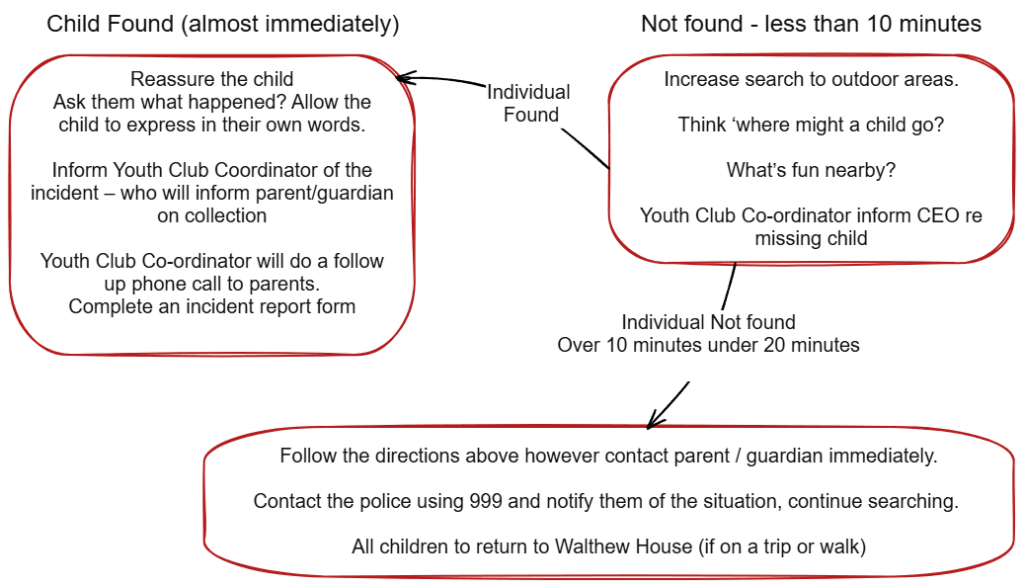
Not found – Over 20 minutes
- Police will be in charge of the situation by now – follow their directions.
- Parents/ guardians to be contacted by the Youth Club Coordinator
- Arrange for police & person in charge to meet parent/guardian on arrival.
- Youth Club Coordinator to inform CEO to update on situation
Once the child is found a full REVIEW of what happened, involving the Youth Co-ordinator and CEO, will need to be conducted as soon as possible. Other witnesses may need to be involved dependent on the situation.
Uncollected Child Procedure
• All parents/carers are expected to collect their children from the venue at the end of the youth club session.
• In the event of a parent failing to collect a child from Youth Club the following procedure will be followed:-
What to do:
- Ring the parent / guardian’s contact numbers
- Ring the nominated emergency contact
- Inform Youth Club Coordinator
- Ensure that the child has a drink and a snack, keeping him/her safe and occupied so as not to become overly concerned about the situation
- Two members of the team must remain with the child until they are collected
| Speak to parent / guardian on arrival and gain password | <- Contact made | Leave a message for the parent / guardian to make contact within the next 10 minutes |
| On arrival check the persons identification by asking questions on the child’s reg form i.e. DOB, home address, tel no etc. Ask them to call if they reach the parent first. Youth Club Coordinator to keep trying parent / guardian until contact is made. Depending on circumstances decide whether further action is required. | <- Contact made | Contact the second number given on the child’s registration form to request they collect the child & find out if they know the parents/guardians whereabouts. |
No response after 30 minutes
Contact the local police department – seek advice & follow instructions.
Youth Club Coordinator is to inform CEO of situation
Reflect on circumstances of what happened and take appropriate action to avoid it repeating – for example remind parents/carers of finishing time, contact numbers ect