

1. Introduction
Walthew House is committed to safeguarding the welfare, rights, and dignity of adults at risk, particularly those with sight and hearing loss. We recognize that individuals with sensory impairments may face increased vulnerability to abuse, neglect, and exploitation, and we strive to create a safe, inclusive, and respectful environment for all.
This policy outlines our approach to preventing harm, responding to concerns, and promoting the wellbeing of the people we support.
2. Purpose
The purpose of this policy is to:
- Protect adults at risk from abuse, neglect, and exploitation.
- Ensure staff and volunteers understand their safeguarding responsibilities.
- Promote accessible and inclusive safeguarding practices.
- Comply with relevant legislation and guidance.
3. Scope
This policy applies to:
- All staff, volunteers, trustees, contractors, and representatives of Walthew House.
- All services, activities, and interactions involving adults who use our support.
4. Legal and Policy Framework
This policy is guided by:
- The Care Act 2014
- The Mental Capacity Act 2005
- The Human Rights Act 1998
- The Equality Act 2010
- The Data Protection Act 2018 and UK GDPR
- Local Safeguarding Adults Board (LSAB) procedures
5. Definitions
Adult at Risk
An individual aged 18 or over who:
- Has care and support needs (whether or not these are being met),
- Is experiencing or at risk of abuse or neglect,
- Is unable to protect themselves due to those needs.
Types of Abuse
- Physical
- Emotional/Psychological
- Sexual
- Financial or Material
- Neglect and Acts of Omission
- Discriminatory (including sensory impairment discrimination)
- Institutional
- Domestic Abuse
- Modern Slavery
- Self-Neglect
6. Roles and Responsibilities
- Designated Safeguarding Officer (DSO): Oversees safeguarding procedures, responds to concerns, liaises with external agencies.
- Deputy DSO: Supports the DSL and acts in their absence.
- Staff and Volunteers: Recognize signs of abuse, report concerns, follow safeguarding procedures.
- Safeguarding Trustee Lead: Oversees policy, supports the Designated Safeguarding Lead, and ensures safeguarding is embedded in governance and practice.
- Trustees: Ensure safeguarding is embedded in governance and strategic planning.
All individuals working with the charity must complete safeguarding training and adhere to this policy.
7. Procedures:
Walthew House adopts a “4 R” approach Recognise, Respond, Refer and Record:
Recognising Abuse
Included at Appendix A isa comprehensive and easy-to-understand Understanding Abuse and Harm table that outlines different types of abuse, key indicators, and potential harms to help staff, volunteers, and stakeholders recognize and respond appropriately.
Staff and volunteers at Walthew House should pay particular attention to the fact that communication barriers may prevent disclosure. For example individuals may rely on others for communication, mobility, or daily living and discriminatory attitudes may lead to exclusion or mistreatment.
Responding to Disclosures
When an adult discloses abuse:
- Listen calmly and respectfully.
- Use accessible communication methods (e.g., British Sign Language, tactile signing, large print).
- Do not promise confidentiality—explain the need to share information.
- Promptly seek guidance from the Duty Officer on how to record the disclosure appropriately and in line with policy
Refer the Concerns
All safeguarding concerns must be Reported immediately to the DSO or Deputy DSO.
They will decide if they will refer and / or seek advice the Stockport Council Multi-Agency Safeguarding and Support Hub (MASHH) See section 18 for contact details.
If someone is in immediate danger, emergency services must be contacted (999).
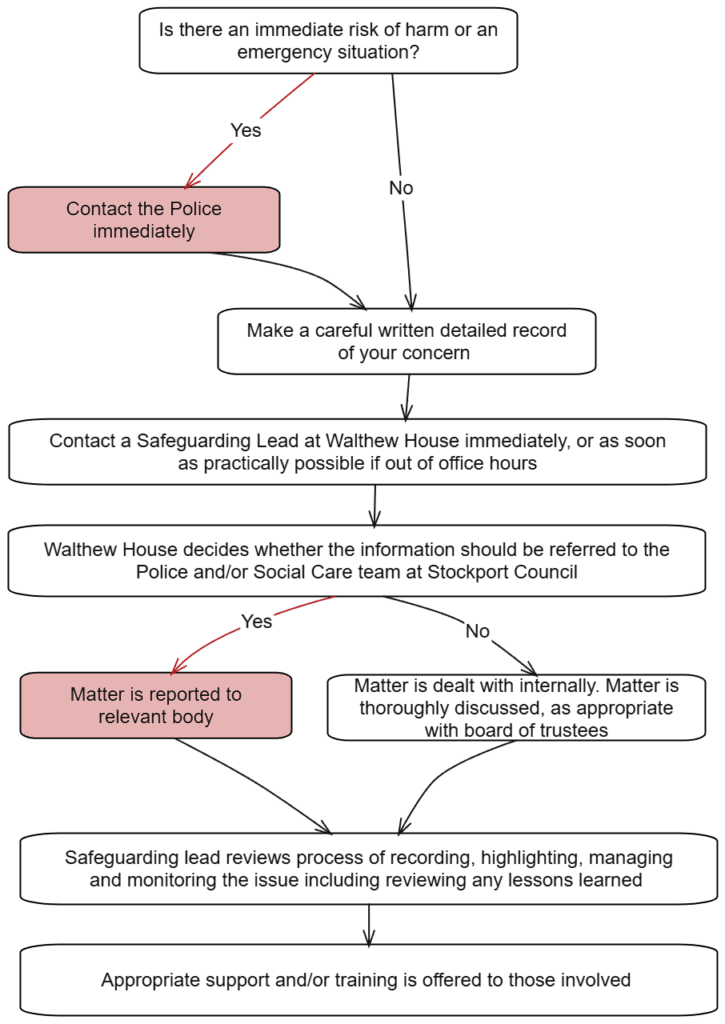
Included at Appendix B is a flow diagram that illustrates the process.
Record the Concern
Objective information, facts, actions, dates, and times must be recorded. These will be stored in line with data protection policy:
- The duty officer with support from the DSO will record using the Safeguarding Concern Log (Appendix C).
- Treated confidentially and sensitively, get guidance from the safeguarding officer
Managing allegations made against a staff member, volunteer or Trustee.
Adults at risk can be subjected to abuse by those who work with and come onto contact with them in any and every setting. All allegations of abuse or maltreatment by any member of staff will be dealt with swiftly and in accordance with these procedures:
- The worker must ensure that the adult is safe and away from the person against whom the allegation is made.
- The Named Person(s) for safeguarding should be informed immediately.
- In the case of an allegation involving the Named Person, alternative arrangements should be sought to ensure that the matter is dealt with by an independent person. (Note: this could be the Deputy Named Person, a Trustee or anyone within the organisation that is in a senior position and believed to be independent of the allegations being made).
- The Named Person(s) should contact the local Social Work department for advice on how to proceed with the immediate situation. Outside of working hours the Emergency Duty Team can give advice, and/or in the event of an emergency situation arising, the police (101/999).
- The individual who first received/witnessed the concern should make a full written record of what was seen, heard and/or told as soon as possible after observing the incident/receiving the report.
- It is important that the report is an accurate description. The Named Person (if appropriate) can support the worker during this process but must not complete the report for the worker.
- This report must be made available on request from either the police and/or social work.
- Regardless of whether a police and/or social services investigation follows, Walthew House will ensure that an internal investigation takes place and consideration is given to the operation of disciplinary procedures. This may involve an immediate suspension and/or ultimate dismissal dependant on the nature of the incident (see our Disciplinary policy).
Reporting a caution or conviction
If an employee who works with children or vulnerable adults in regulated activity has been cautioned or convicted for a relevant offence Walthew House must make a referral to the DBS. Such a disclosure must be referred immediately to the Designated Safeguarding Lead who will then make a referral to the DBS.
A relevant offence is a serious offence that will, subject to consideration of representations where permitted, automatically bar a person from working with children or vulnerable adults.
Whistleblowing
Walthew House recognises the importance of building a culture that allows all staff to feel comfortable about sharing information, in confidence and with a lead person, regarding concerns they have about a colleague’s behaviour. This will also include behaviour that is not linked to safeguarding but that has pushed the boundaries beyond acceptable limits.
9. Consent and Mental Capacity
- Adults have the right to make unwise decisions unless they lack capacity.
- If an adult lacks capacity, decisions must be made in their best interests.
- Consent should be sought before sharing information unless there is a risk of serious harm.
10. Confidentiality and Information Sharing
- Information will be shared on a need-to-know basis.
- Records will be stored securely and accessibly.
- The charity complies with data protection legislation and respects individuals’ privacy.
11. Complaints procedure
Walthew House has a clear procedure to deal with complaints from service users, volunteers and employees. Please refer to the Walthew House Complaints, Comments and Compliments Procedure. Consideration should always be given to whether a complaint meets the criteria for a safeguarding referral or managing allegations procedures.
12. Training and Awareness
All staff and volunteers will receive:
- Safeguarding training tailored to sensory impairment.
- Regular updates and refreshers.
- Guidance on inclusive communication and accessibility.
13. Monitoring and Review
This policy will be:
- Reviewed annually or after any safeguarding incident.
- Updated to reflect changes in legislation or best practice.
- Approved by the Board of Trustees.
14. Contact Details
Operational Safeguarding Officer (DSO):
Name: Nik Noone
Job role: CEO
Email address: exec@walthewhouse.org.uk
Telephone number: 0161 480 2612
Trustee Safeguarding Officer:
Name: Gina Hannan
Email address: admin@walthewhouse.org.uk
Telephone number: 0161 480 2612
Stockport Council Multi-Agency Safeguarding and Support Hub (MASHH)
Online form: Contacting the MASSH – Stockport Council
Telephone number: 0161 217 6028
Police:
Emergency (immediate risk of harm): 999
Non-emergency: 101
15. Document Control
Document Title: Safeguarding Adults Policy
Version: 2.0
Date Approved: 13.08.25
Review Date: August 2026
Approved By: Rachael Zimbler, Chair of Trustees.
Appendix A Understanding Abuse and Harm
The following table outlines different types of abuse, key indicators, and potential harms to help staff, volunteers, and stakeholders recognize and respond appropriately.
| Type of Abuse | Description | Possible Indicators | Potential Harms |
| Physical Abuse | Intentional use of physical force that results in injury or pain. | Unexplained bruises, burns, fractures, fearfulness, flinching. | Physical injury, trauma, long-term disability, emotional distress. |
| Emotional Abuse | Persistent emotional maltreatment that damages self-esteem and development. | Withdrawal, anxiety, low self-worth, excessive criticism, fear of making mistakes. | Depression, anxiety, poor social skills, self-harm. |
| Sexual Abuse | Forcing or enticing someone to take part in sexual activities without consent. | Inappropriate sexual knowledge, physical discomfort, secrecy, sudden behaviour changes. | Trauma, STIs, pregnancy, shame, PTSD. |
| Neglect | Failure to meet basic physical and emotional needs. | Poor hygiene, malnutrition, unattended medical needs, developmental delays. | Illness, developmental issues, emotional withdrawal. |
| Financial Abuse | Illegal or unauthorized use of someone’s money or assets. | Sudden financial difficulties, missing possessions, unexplained transactions. | Poverty, loss of independence, stress. |
| Institutional Abuse | Mistreatment within care settings due to poor practices or neglect. | Lack of choice, rigid routines, unsafe environments, disrespectful treatment. | Loss of dignity, poor health outcomes, isolation. |
| Discriminatory Abuse | Harassment or unfair treatment based on race, gender, disability, etc. | Derogatory language, exclusion, unequal treatment, fear of certain groups. | Isolation, low self-esteem, mental health issues. |
| Online Abuse | Abuse via digital platforms including cyberbullying, grooming, exploitation. | Secretive online behaviour, distress after internet use, inappropriate messages/images. | Emotional harm, exploitation, reputational damage. |
| Domestic Abuse | Abuse between intimate partners or family members. | Controlling behaviour, physical injuries, fearfulness, isolation. | Physical and emotional trauma, homelessness, long-term psychological effects. |
| Self-Neglect | When a person fails to care for their own basic needs. | Poor hygiene, hoarding, refusal of help, malnutrition. | Health deterioration, isolation, risk of death. |
| Modern Slavery | Exploitation through forced labour, human trafficking, or servitude. | Poor living conditions, fearfulness, no personal documents, restricted freedom. | Physical and psychological trauma, loss of autonomy. |
Notes for Use
- This table should be used as a reference tool for anyone involved in safeguarding.
- Indicators are not definitive proof of abuse but should prompt further inquiry or reporting.
- Always follow our reporting procedures and consult with designated safeguarding lead
Appendix B Reporting Flow Chart
Appendix C Safeguarding Concern Log
| Date: | |
| Who does the concern relate to | |
| Name of contact who raised the concern | |
| DOB: | |
| Gender: | |
| Ethnicity: | |
| Disability: | |
| Religion / Faith: | |
| Sexual Orientation: | |
| Why are you concerned? | |
| Define the type of Safeguarding Concern or abuse | |
| What outcome does the service user want? | |
| Action Taken and by Whom | |
| Who else was informed Line Manager Safeguarding Lead | |
| Outline the Progress | |
| What was the outcome? | |
| What worked well? | |
| What lessons were learnt? |